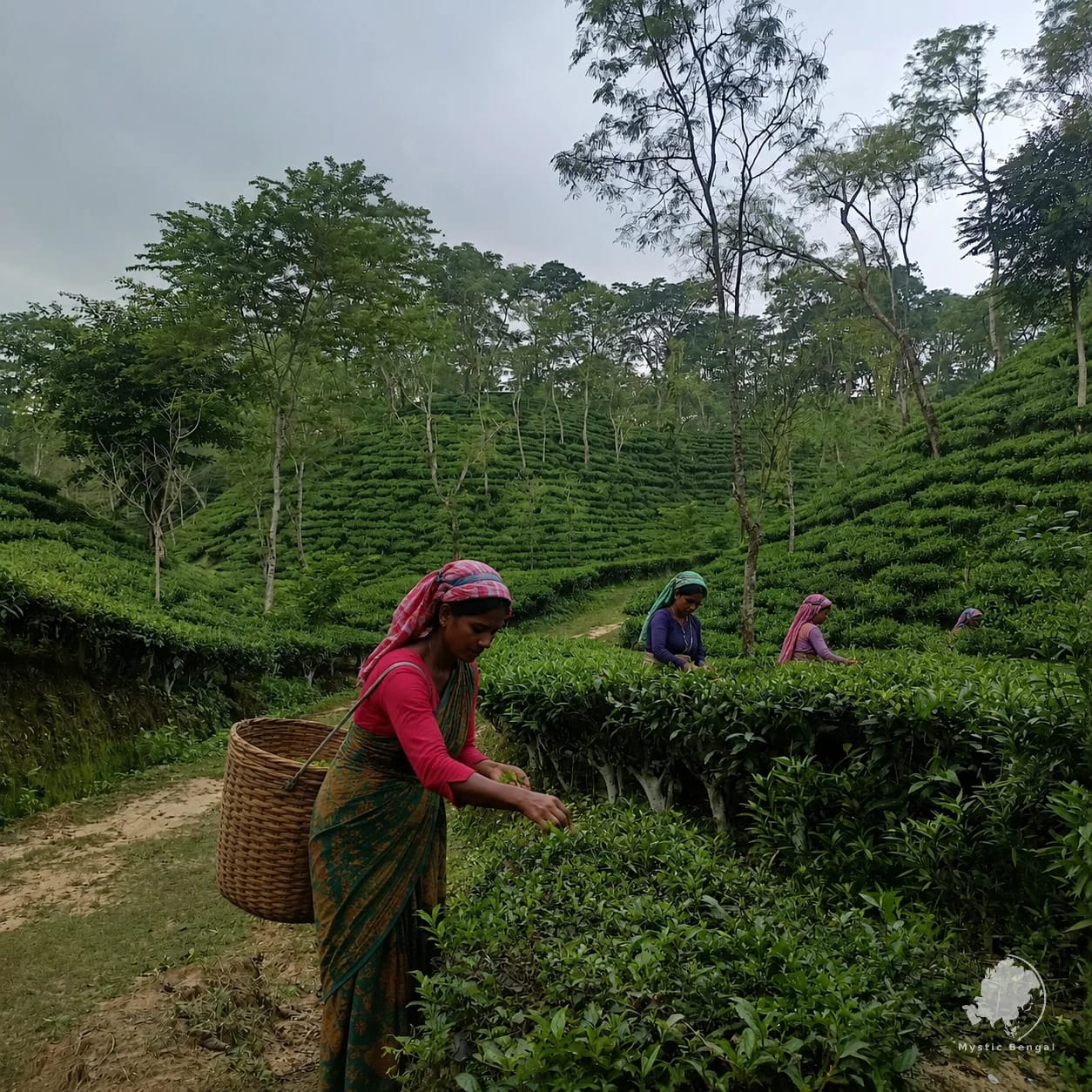
Srimangal is where Bangladesh slows down. The town sits in a bowl of tea gardens in Moulvibazar district, and within ten minutes of leaving it you are on red dirt tracks between waist-high tea bushes and shade trees, with pickers working the slopes and baskets going in on their backs by late afternoon.
Tea has shaped everything here since the British planted the first estates in the 1850s. The bushes, the shade trees planted in rows above them, the labour lines where workers live, the factories with their long louvred withering lofts — all of it is industrial landscape, just an unusually beautiful one.
It is the easiest place in the country to spend two unhurried days: rainforest in the morning, tea estate in the afternoon, a glass of the famous seven-layer tea somewhere in between. Nobody comes to Srimangal to tick things off, which is precisely its appeal.
Tea gardens and how to see them properly
The estates around Srimangal are working plantations, not parks, and that is worth remembering before you wander in. The best way to see them is on a bicycle or by slow car along the estate roads early in the morning, when the pickers are out, the mist is still sitting in the hollows, and the light comes in low over the bushes.
Pickers work to a daily weight quota and are paid accordingly, which is a harder life than the scenery suggests. Most are descended from labourers brought from Odisha, Bihar and elsewhere in India in the nineteenth century, and many communities still speak their own languages. Ask before photographing anyone, and if you buy tea, buy it at the estate.
Several estates allow factory visits by arrangement, and they are worth the trouble. You can follow leaf from the withering trough through the rollers to the drier and the sorting screens, in buildings that have not changed much in a century. Ask your guide to set it up a day ahead rather than turning up at the gate.
For the postcard version, the Nurjahan and Finlay estates are the ones people photograph, and the tea research institute at Srimangal has neatly terraced slopes. But almost any estate road will do — this is one of the few places where the ordinary view is as good as the famous one.
Lawachara National Park
Lawachara is a patch of semi-evergreen rainforest 15 minutes from town, about 1,250 hectares of it, and one of the last homes of the hoolock gibbon in Bangladesh. Perhaps sixty of them remain in the park. Trails run from 30 minutes to three hours; the short ones are easy and well used, the long ones muddy and much quieter.
Go at dawn if you want to hear the gibbons. They call at first light — a rising, whooping duet between mated pairs that carries a kilometre through the canopy — and it is one of the great animal sounds anywhere in Asia. Hearing them is close to guaranteed; seeing them takes patience and a guide who knows which fruiting trees they are using that week.
A forest guide is required at the gate and worth every taka. They will find things you would walk straight past: stick insects, a roosting owl, the trail of a python across the path. The park also holds the Khasi villages inside its boundary, where betel leaf is grown on vines trained up the trees, and a section of the old Dhaka–Sylhet railway line runs right through the forest.
- Hoolock gibbons, capped langurs and macaques
- Over 240 recorded bird species
- The Khasi villages inside the park boundary, where betel leaf is grown on tree vines
Seven-layer tea and where to drink it
Srimangal invented seven-layer tea, and it is exactly what it sounds like: different densities of tea, milk, spice and syrup, poured so carefully that they sit in visible bands in a single glass and stay there. Romesh Ram Gour, a local tea maker, worked out the trick in the early 2000s and it has been imitated across the district ever since.
It is a novelty, and any honest person will tell you the individual layers are not the best tea you will drink here. Go anyway. The small stalls that make it are the most sociable places in town, and the plain, strong, milky tea sold on every corner for a few taka is the real local drink.
Buy loose leaf to take home from an estate shop rather than the tourist stalls, and ask for the second flush if it is the season.
Srimangal in pictures

Things to do in Srimangal
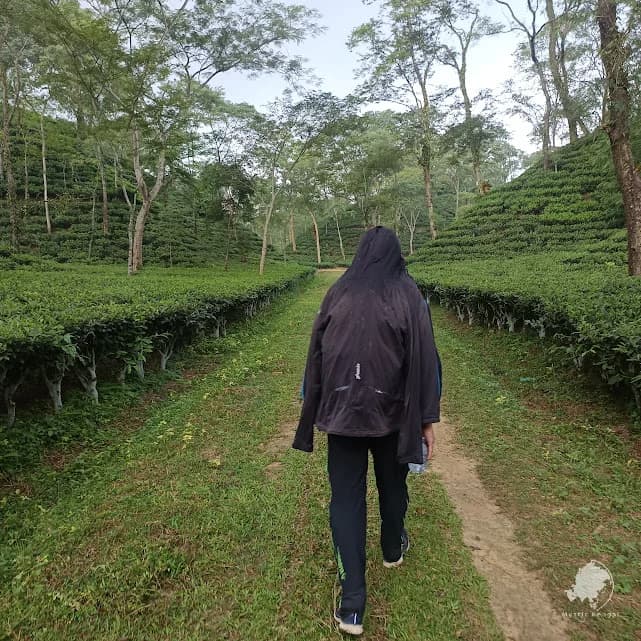
Cycle through the tea estates
Rent a bicycle and take the red dirt roads between gardens at sunrise. No entrance fee, no crowd, the best photography of the trip.
Lawachara National Park trek
One to three hour forest trails with a guide, looking for hoolock gibbons and hornbills.
Madhabpur Lake
A quiet lake ringed by tea gardens, good for an hour and a picnic.
Tea factory visit
Follow the leaf through withering, rolling, oxidation and drying — arrange a day in advance.
Seven-layer tea
The town speciality, served in glass so you can see the bands.
Ham Ham waterfall
A full day hike through hill forest to a remote waterfall near the Indian border, for the fit and the muddy.
Best time to visit
October to March. Cool, dry, and the tea gardens are still green from the rains. Winter mornings can be misty in a way that suits the landscape.
Ideal months
When to avoid: Heavy monsoon in June and July, when forest trails turn to mud and leeches are relentless.
- The plucking season runs roughly April to December — outside it the gardens are quieter and less photogenic.
- Bring a light jacket for December and January mornings.
How to get there
Dhaka by train6 hours
Direct intercity trains to Srimangal station. The most pleasant route — book Snigdha class.
Dhaka by road5 hours
Air-conditioned coach or private car via Bhairab and Habiganj.
From Sylhet1.5 hours
An easy 90 minute drive, which makes Srimangal and Sylhet a natural pair.
Travel tips
- Ask before photographing tea pickers — they are at work, not on display.
- Bring leech socks or long trousers tucked into socks for Lawachara after rain.
- Stay in an estate bungalow or eco-resort rather than in town if you can; the setting is the point.
- Book a guide for the national park at the gate and agree the route and price up front.
- Buy tea directly from an estate shop rather than the tourist stalls if you want the good stuff.
Nearby attractions
Sylhet
1.5 hours
Shrines, the Surma river and a base for Ratargul and Jaflong, 90 minutes north.
Read the guideMadhabkunda waterfall
2 hours
The tallest waterfall in the country, about two hours east.
Baikkha Beel
45 minutes
A wetland sanctuary that fills with migratory waterbirds in winter.
Srimangal: common questions
How many days do I need in Srimangal?
Two nights is right: one day for the tea estates and Madhabpur Lake, one morning for Lawachara. Add a day if you want the Ham Ham waterfall hike or Baikkha Beel birding.
Can I visit a working tea factory?
Yes, several estates allow factory visits if arranged in advance through a guide or your accommodation. Turning up unannounced usually does not work — these are production sites with shift schedules.
Will I see gibbons at Lawachara?
Often, if you go at dawn with a guide. Hoolock gibbons are loud at first light, which makes them easier to locate than to spot. Midday visits rarely produce sightings.
Is Srimangal good for families?
Very. Distances are short, the walking is easy, and the tea gardens, lake and short forest trails work well for children.
Where to go next

Sylhet Division
Sylhet
Shrine city on the Surma river, and the gateway to Ratargul swamp forest, Jaflong stone beds and the haor wetlands of the northeast.

Khulna Division
The Sundarbans
The largest mangrove forest on earth, and the only one where tigers swim between islands. Three nights on a live-aboard boat is the way to see it.

Chattogram Division
Cox's Bazar
The longest natural sea beach in the world — 120 kilometres of unbroken sand, best experienced away from the crowded main strip.
Travel to Srimangal with a local team
We handle permits, transport, guides and the timing that makes the difference between a good trip and a wasted one.
Sources and further reading
- Sreemangal Upazila — Wikipedia
- Lawachara National Park — Wikipedia