
Rajshahi division holds the best surviving architecture of two eras that shaped Bengal: the Ilyas Shahi and Husain Shahi sultans who built in black basalt and terracotta between the 15th and 16th centuries, and the zamindar families who covered their temple towns in figurative terracotta in the 18th and 19th. Almost none of it appears on standard tourist itineraries, which is precisely why the sites are quiet.
The route works as a loop. Chapai Nawabganj, on the Indian border, has Choto Sona Mosque, Darasbari Mosque and the Tohakhana complex — all of them fragments of the old capital of Gaur, whose other half lies across the frontier in Malda. Naogaon has Kusumba Mosque. Rajshahi district has Puthia and Bagha. Natore has the Dighapatia palace, now Uttara Gano Bhaban. Three days of driving connects the lot.
Choto Sona Mosque and the ruins of Gaur
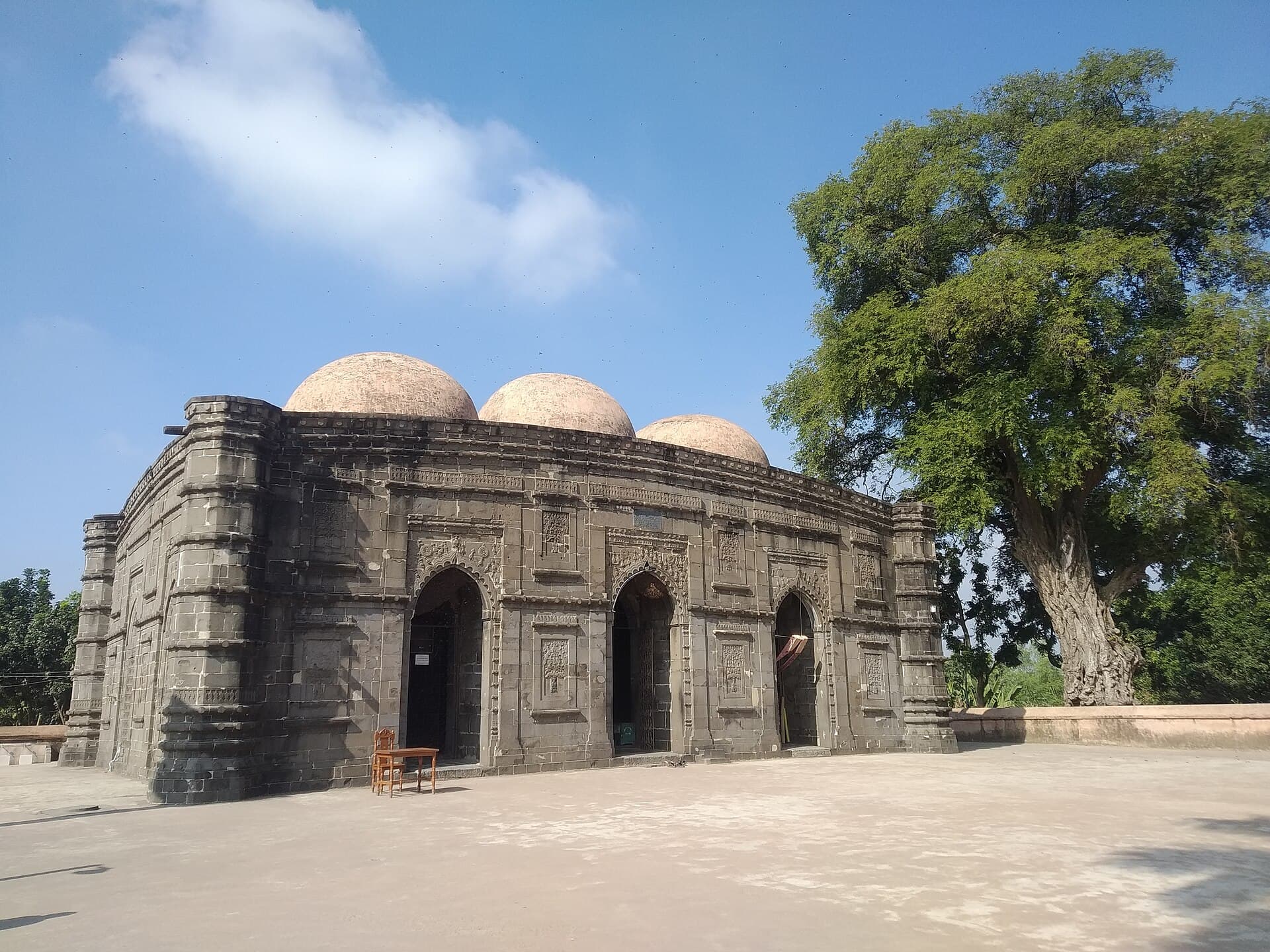
Choto Sona Mosque — the Small Golden Mosque — was built around 1493–1519 under Alauddin Husain Shah, and it is the best preserved sultanate mosque in Bangladesh. The walls are dressed stone rather than brick, carved edge to edge with rosettes, hanging-lamp motifs and creeper bands, and the fifteen domes over the prayer hall include a rare row of chau-chala vaults imitating the curve of a thatched Bengali roof. The gilding that gave it its name is long gone.
It stands in Shibganj upazila of Chapai Nawabganj, inside what was once Gaur, capital of Bengal for most of the 14th to 16th centuries. Partition split the city: the citadel and its most famous gateways ended up in Malda in India, and this side of the line kept Choto Sona, Darasbari, the Tohakhana complex and Shah Niamatullah’s tomb and mosque.
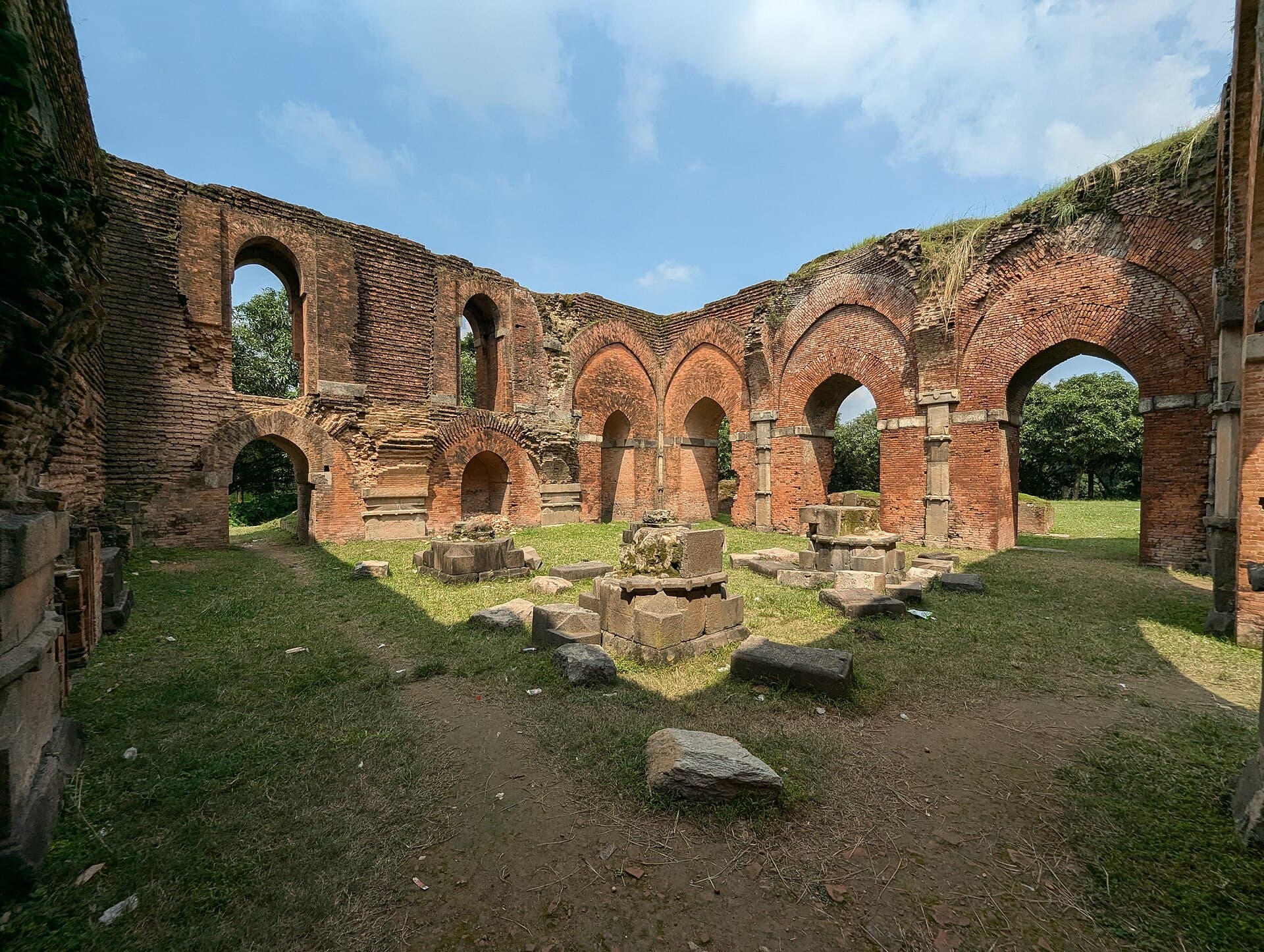
Darasbari Mosque, a couple of kilometres on, is the counterweight — built in 1479, roofless now, its arcades open to the sky and its stone mihrabs still carrying deep relief carving. It is one of the largest sultanate mosques in the country and one of the least visited.
Kusumba Mosque, Naogaon
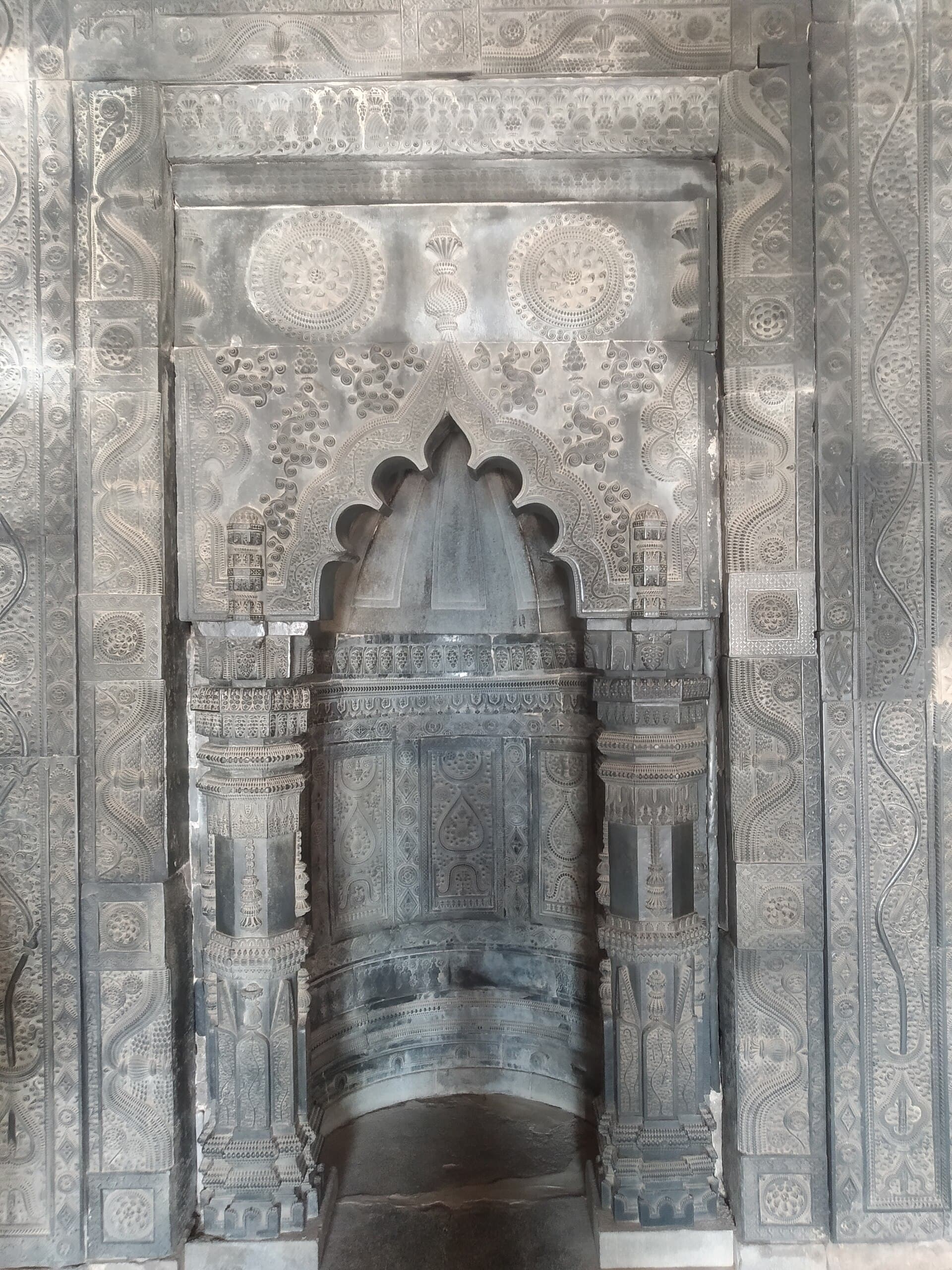
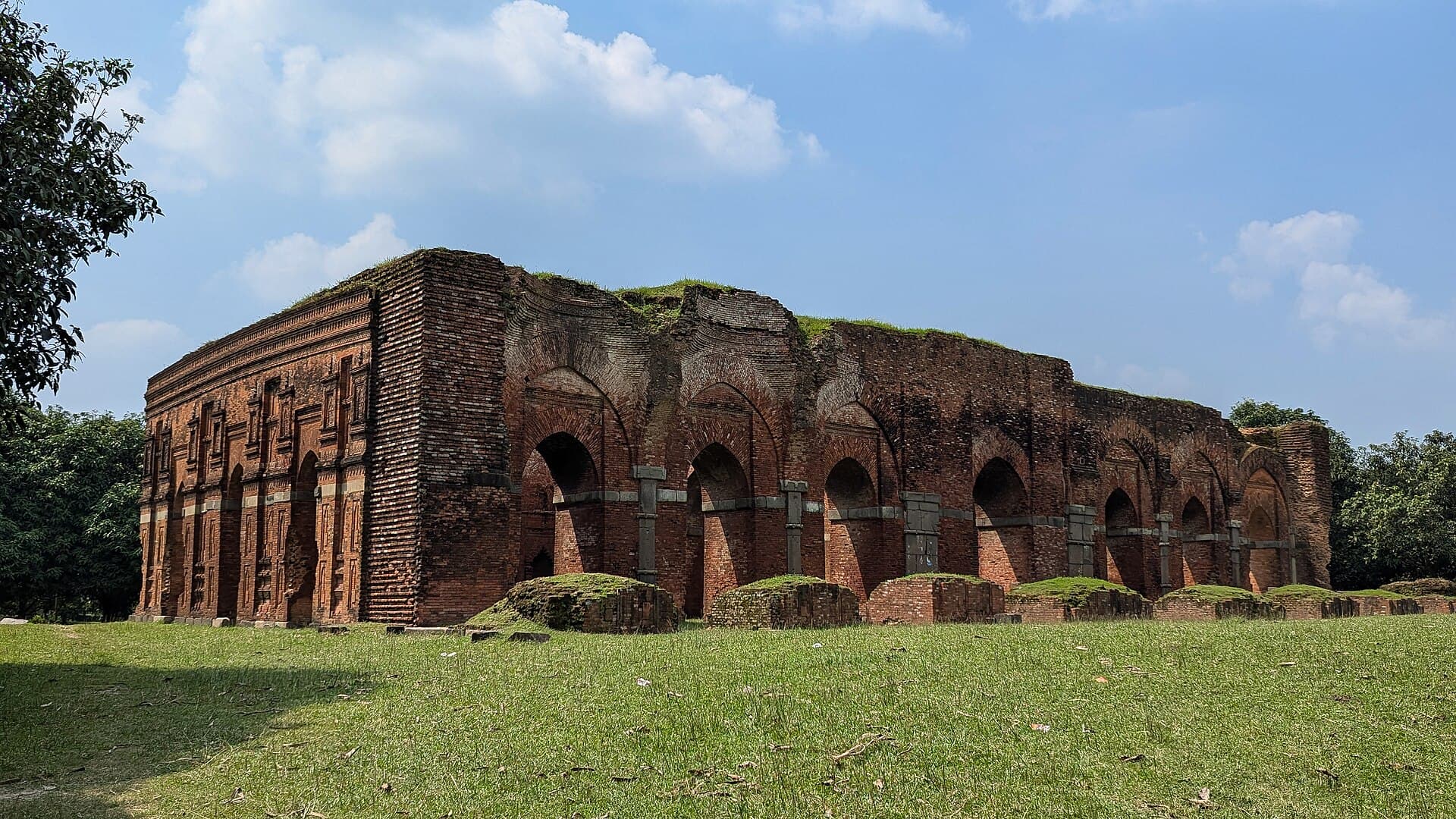
Kusumba Mosque was completed in 1558, during the brief Suri interlude between the Sur and Karrani dynasties, and it is the most complete stone building of its period in Bangladesh. A rectangular hall under six domes sits on a raised platform beside a large tank, faced inside and out in grey-black basalt, with mihrabs cut in relief so crisp that individual lotus petals still read after four and a half centuries.
One of its mihrabs sits on a raised stone platform reached by steps — an unusual arrangement thought to have served as a royal or governor’s enclosure. The mosque appears on the Bangladeshi five taka note, which is how most visitors recognise it before they arrive.
Puthia: the temple town
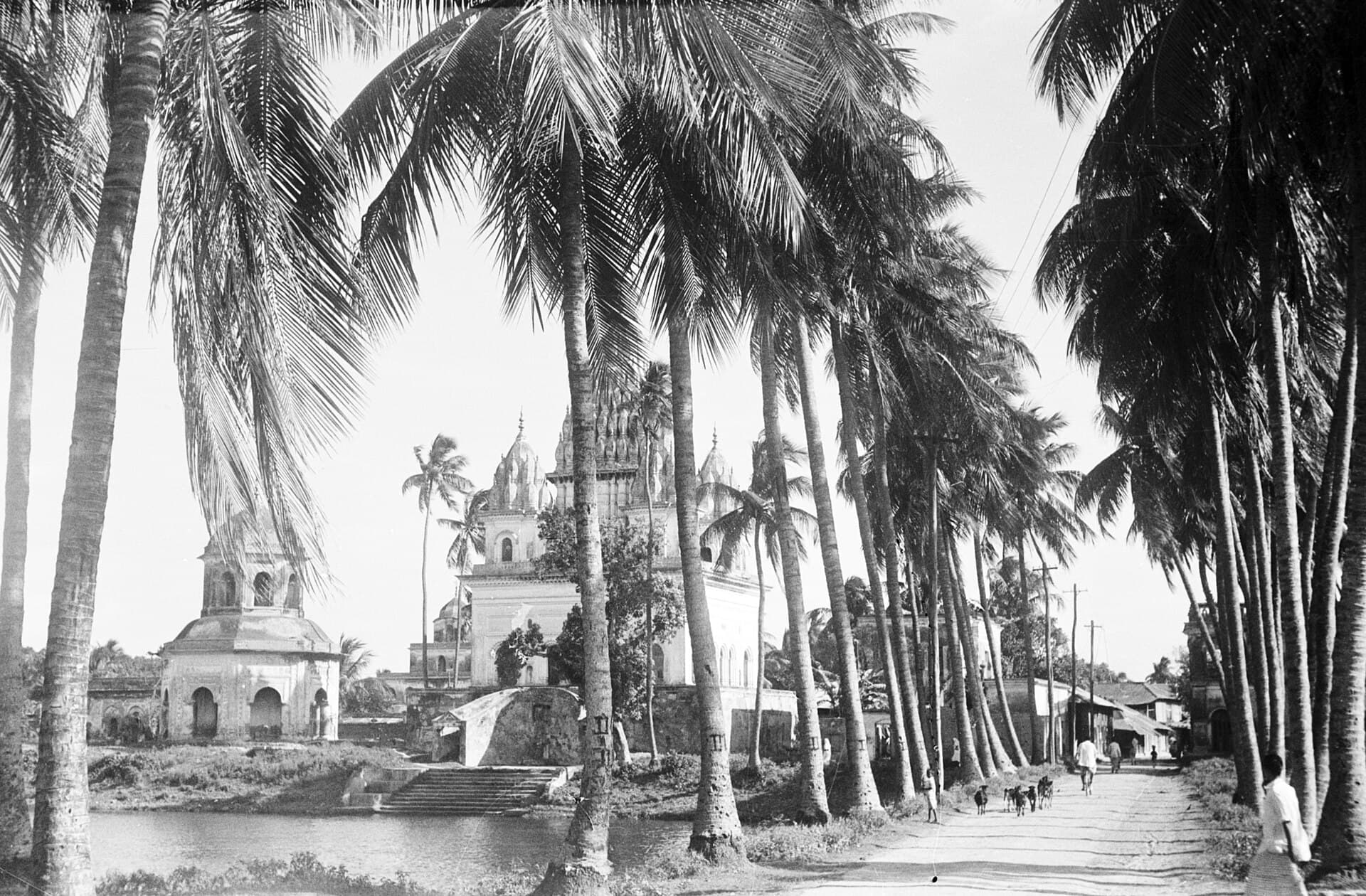
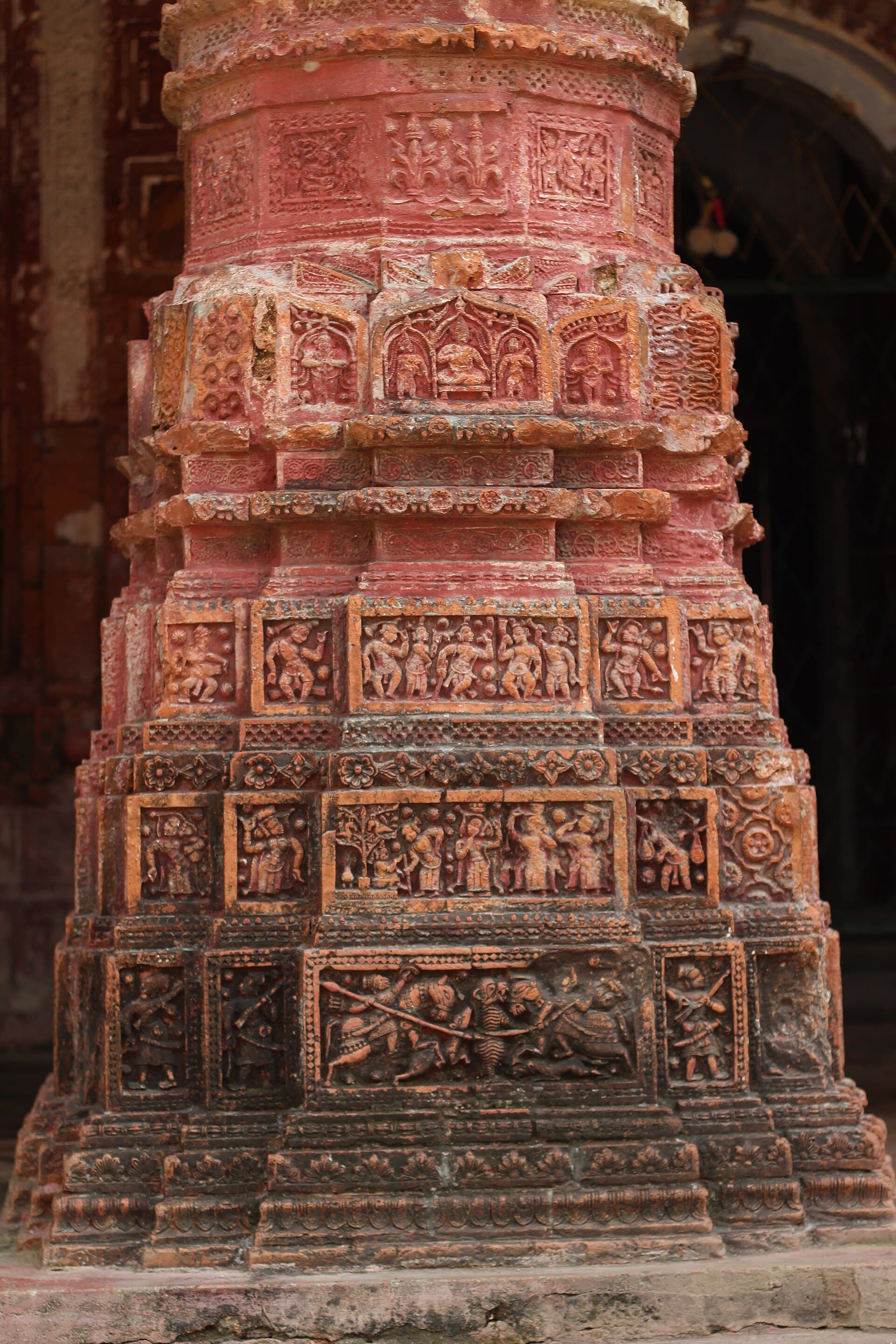
Thirty kilometres east of Rajshahi city, Puthia holds the densest concentration of historic Hindu temples in Bangladesh, built by the Puthia zamindar family between the 16th and 19th centuries around a pair of ponds and a palace. The Bara Ahnik Mandir, Govinda Temple, Gopala Temple, Dol Mancha and the great Bhubaneshwar Shiva Temple all stand within walking distance of each other.
The Shiva temple is the largest of its type in the country, a five-spired pancharatna structure on a high plinth. The Govinda Temple is the one to linger at: every exposed surface of its walls carries terracotta panels of scenes from the Ramayana, the Mahabharata and the Krishna legends, worked at a scale that rewards a slow circuit.
The Puthia Rajbari itself — a European-fronted palace of 1895 — closes the square. It houses a college now, but the facade and the forecourt are freely visitable.
Natore, Uttara Gano Bhaban and Bagha
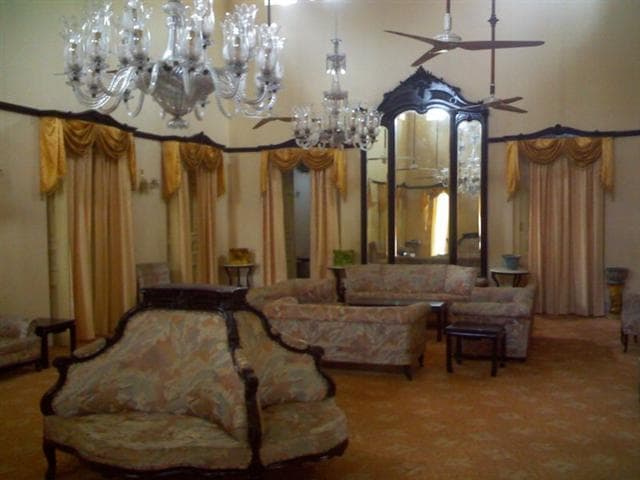
The Dighapatia Rajbari at Natore was built by a zamindar family in the 18th century, rebuilt after the 1897 earthquake, and taken over by the state in 1972 as Uttara Gano Bhaban — the northern residence of the head of government. Its Italianate front, marble hall and formal gardens are open to visitors when no official function is in progress. Natore Rajbari, seat of the Rani Bhabani estate, sits a few kilometres away with its own cluster of temples and ponds.
South of Puthia at Bagha, the mosque of 1523 is worth the detour for its terracotta alone — the entire brick surface is covered in floral and geometric panels, and the surrounding tank and graveyard make it the most photogenic stop on the route.
- Rajshahi city to Puthia: 30 km, about 45 minutes
- Rajshahi to Natore: 40 km, roughly an hour
- Rajshahi to Kusumba Mosque: about 2 hours via Naogaon
- Rajshahi to Choto Sona and Darasbari: 40 km to Shibganj, about 1.5 hours
Historical Sites of Rajshahi in pictures
Things to do in Historical Sites of Rajshahi
Choto Sona Mosque
Study the stone carving up close, then walk to the chau-chala domes at the centre of the roofline — the detail that makes this mosque distinctive.
Darasbari Mosque
A roofless 1479 prayer hall a few hundred metres from the Indian border, usually completely empty of visitors.
Tohakhana complex
A three-storey Mughal residence, hammam and mosque built for Shah Shuja beside the tomb of Shah Niamatullah Wali.
Kusumba Mosque
The 1558 stone mosque on the five taka note, best photographed from across its tank in the late afternoon.
Puthia temple square
Five major temples, a palace and two ponds inside a single walkable square — the richest terracotta in Bangladesh.
Uttara Gano Bhaban, Natore
The Dighapatia palace and its formal gardens, open to the public outside official visits.
Bagha Mosque
A 1523 mosque whose entire brick exterior is worked in terracotta panels, set beside a large tank.
Varendra Research Museum, Rajshahi
The oldest museum in Bangladesh, holding the best collection of Pala and Sena stone sculpture in the country.
Best time to visit
November to February. Rajshahi is the hottest part of Bangladesh in summer, and almost every site on this route is unshaded stone or open temple courtyard.
Ideal months
When to avoid: April to June — Rajshahi regularly records the country’s highest temperatures, above 40°C, and the stone radiates heat all afternoon.
- Late June to August is mango season across Chapai Nawabganj and Rajshahi, worth timing for despite the heat.
- Winter fog can delay morning starts in December and January.
- Hindu festivals bring the Puthia temples alive; Durga Puja in autumn is the biggest.
How to get there
Dhaka to Rajshahi by air55 minutes
Daily domestic flights, the fastest way in. Rajshahi city is the natural base for the whole loop.
Dhaka to Rajshahi by train5–6 hours
The Padma, Silkcity and Banalata intercity services. Banalata is the quickest and runs non-stop; book Snigdha class.
Dhaka to Rajshahi by road6–7 hours
Air-conditioned coach via the Jamuna Bridge and Natore.
Rajshahi to Chapai Nawabganj1.5 hours
Bus or hired car to Shibganj for Choto Sona, Darasbari and Tohakhana, which are within a few kilometres of one another.
Getting between sites
A hired car with a driver for two or three days is far more practical than local buses, which do not connect the sites directly.
Travel tips
- Hire a car for the full loop. The sites sit in four different districts and public transport between them costs more time than it saves money.
- Darasbari and Choto Sona are close to the border; carry your passport, and expect a friendly check by border guards.
- Cover your head and shoulders at the mosques, and remove shoes before entering prayer halls. Some close to non-Muslim visitors at prayer times.
- The Puthia temples are active places of worship — ask before photographing anyone at prayer.
- Government archaeological sites close one weekday and break for lunch; confirm timings locally before setting out.
- Rajshahi city has the only reliable hotels and ATMs on the route.
- Do not miss the mangoes if you visit between late June and August — Chapai Nawabganj is the centre of the trade.
Nearby attractions
Paharpur (Somapura Mahavihara)
2.5 hours from Rajshahi
The UNESCO-listed Buddhist monastery, an easy extension north from Naogaon.
Read the guideMahasthangarh
3.5 hours from Rajshahi
The oldest city site in Bangladesh, in Bogura district.
Read the guideBagha Mosque
50 km from Rajshahi
A 1523 terracotta mosque south-east of Rajshahi city, often paired with Puthia in one day.
Varendra Research Museum
In Rajshahi city
Bangladesh’s oldest museum, in Rajshahi city itself.
Historical Sites of Rajshahi: common questions
What are the main historical sites in Rajshahi division?
Choto Sona Mosque, Darasbari Mosque and the Tohakhana complex in Chapai Nawabganj; Kusumba Mosque in Naogaon; the Puthia temple complex and Bagha Mosque in Rajshahi district; and Uttara Gano Bhaban with Natore Rajbari in Natore. Paharpur and Mahasthangarh are also in the division and usually treated as a separate two-day trip.
How many days do I need for the Rajshahi heritage circuit?
Three days is comfortable with a hired car — one for Puthia, Bagha and the Varendra Museum, one for Chapai Nawabganj, and one for Kusumba and Natore. Two days is possible if you drop either Natore or Bagha.
Why is Choto Sona Mosque called the Small Golden Mosque?
Its domes were once gilded, which gave the mosque its name. The gilding is long gone, but the stone carving that covers the walls survives, and it remains the best preserved sultanate-period mosque in Bangladesh.
Is Kusumba Mosque on the five taka note?
Yes. The 1558 mosque at Kusumba in Naogaon district appears on the Bangladeshi five taka note, which is how most Bangladeshis know it before ever visiting.
Can I visit Puthia in a day trip from Rajshahi?
Easily. Puthia is 30 kilometres from Rajshahi city, about 45 minutes by road, and the whole temple square is walkable in two or three hours. Pairing it with Bagha Mosque makes a full and unhurried day.
What is Uttara Gano Bhaban?
The 18th century Dighapatia Rajbari at Natore, taken over by the state in 1972 and used as the northern official residence of the head of government. The palace and its gardens are open to visitors except when an official function is being held.
Do I need a permit for the border-area mosques?
No permit, but Darasbari and Choto Sona sit close to the Indian frontier, so carry photo identification. Border Guard Bangladesh personnel are used to visitors and checks are routine.
Where to go next

Rajshahi Division
Paharpur & Mahasthangarh
The largest Buddhist monastery south of the Himalayas and the oldest city site in Bangladesh, an hour apart in the northern plains. One UNESCO World Heritage Site, one 2,500 year old capital, both doable in two days from Bogura.
Khulna Division
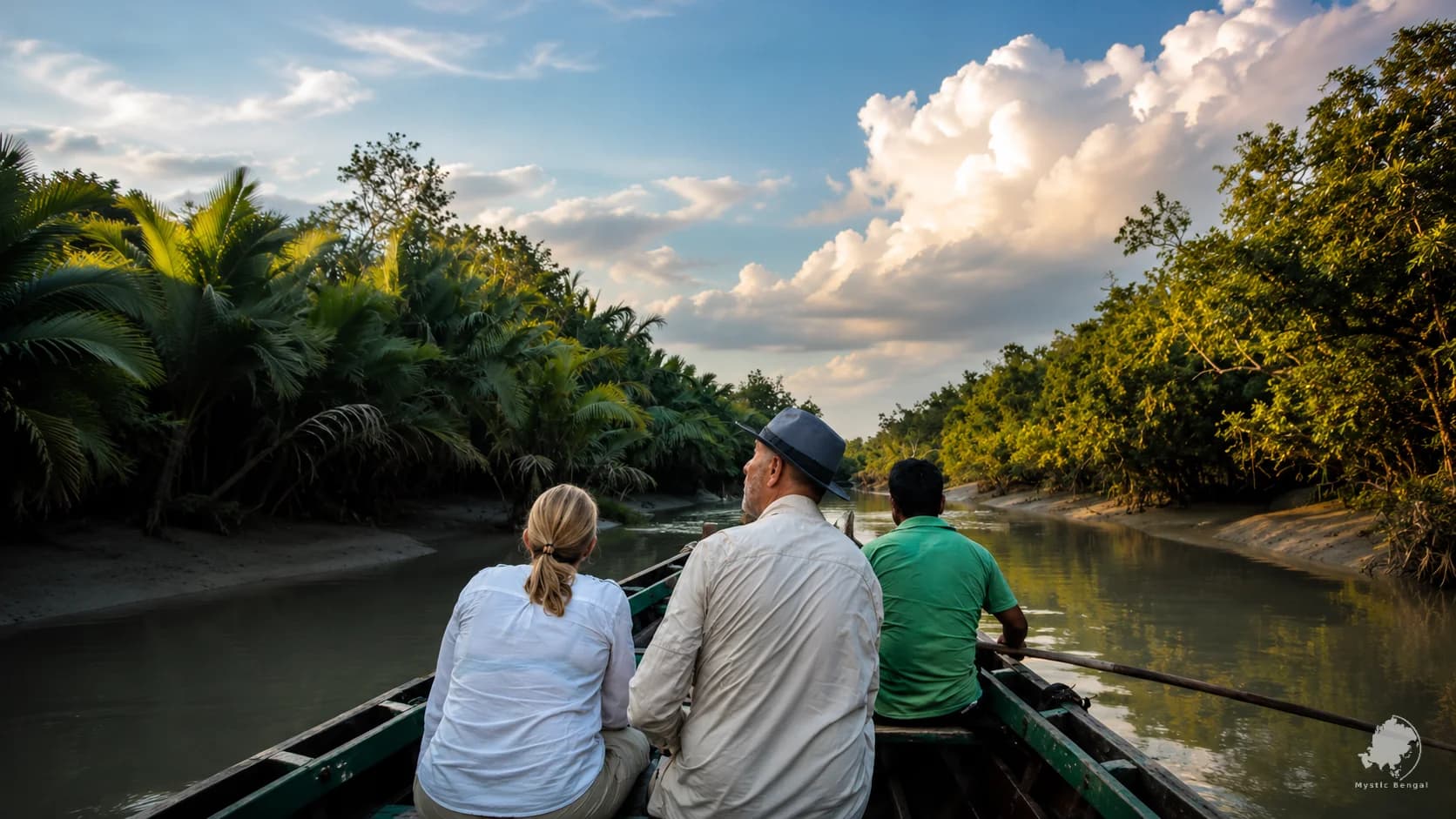
The Sundarbans
The largest mangrove forest on earth, and the only one where tigers swim between islands. Three nights on a live-aboard boat is the way to see it.
Chattogram Division
Cox's Bazar
The longest natural sea beach in the world — 120 kilometres of unbroken sand, best experienced away from the crowded main strip.
Travel to Historical Sites of Rajshahi with a local team
We handle permits, transport, guides and the timing that makes the difference between a good trip and a wasted one.
Sources and further reading
- Choto Sona Mosque — Wikipedia
- Kusumba Mosque — Wikipedia
- Puthia Temple Complex — Wikipedia